What a Cup of Excellence Juror Looks for When Buying Coffee
 Maryna Gray
• June 16, 2026 — last updated June 05, 2026
Maryna Gray
• June 16, 2026 — last updated June 05, 2026
We've all stared at a wall of specialty bags, in a careful grocery aisle or on a roaster's website with a hundred SKUs, and wondered if there's a shortcut past the trial and error. There is, sort of. It just doesn't look like a star rating.
I want you to be able to walk up to any bag of specialty coffee and, in under a minute, know whether it has a real shot at being one of those mugs you keep thinking about for the rest of the morning. The sweet, balanced, alive cup that lingers. Or whether it's the kind that'll disappoint.
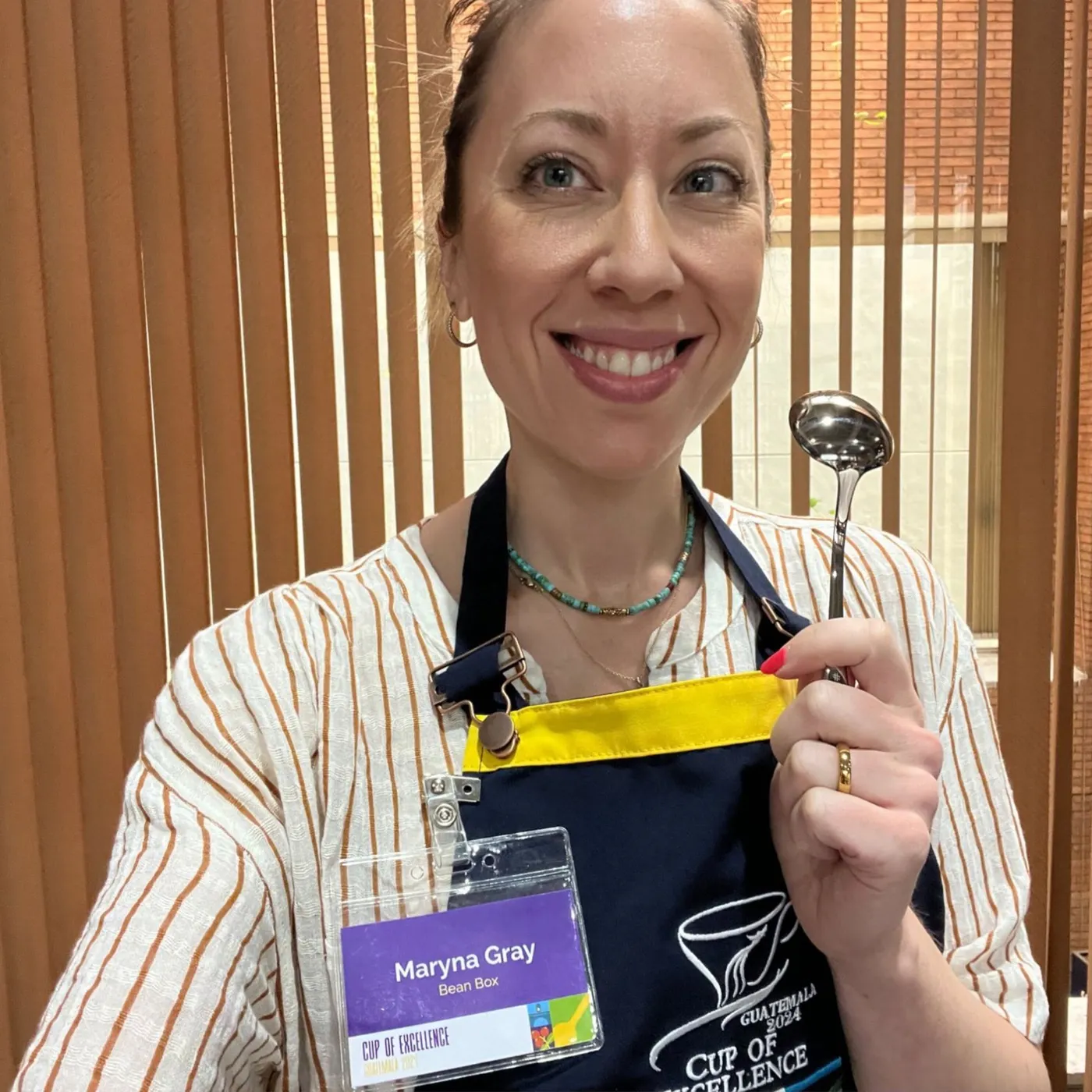
I've cupped at the Cup of Excellence as a juror, and I serve on the Alliance for Coffee Excellence board, the parent organization. I'm going to translate the discipline I use at the cupping table into five things you can actually do when you have one bag in your hand. Not another generic checklist (the internet is already drowning in those) but the disciplined narrowing move I use, broken into reusable steps.
The short answer
We all want to feel confident buying coffee, and you can. I cup at the Cup of Excellence, and here are the five things I actually look for before I commit to a bag.
- Roast date is the gatekeeper. Two to six weeks past roast is the window. Anything else (origin, price, awards) only matters if the coffee is still alive.
- Specificity over breadth. A bag that names a region, a process, a varietal, and tasting notes is a roaster telling you, "I know exactly what's in here." Vague labels almost always cover vague coffee.
- The roaster's hand shows in their words. How a roaster describes one specific coffee, including its origin, why they roasted it that way, who grew it, is the closest you can get to a cupping calibration without sitting at the table.
What it actually means: the CoE cupping lens
Cup of Excellence is the most rigorous quality competition in coffee, and the cupping form is the tool. Jurors don't taste the way most people drink. We taste blind, in flights, across dozens of samples in a session, calibrating across cups until our tongues recognize patterns. I've been at that table, and I serve on the ACE board.
The form scores nine attributes: appearance/uniformity, aroma, flavor, body, acidity, balance, aftertaste, sweetness, and cleanliness. Each gets 0 to 8 points, plus a base of 36, for a total out of 100. To win Cup of Excellence, a coffee needs 87 or higher across multiple rounds of national and international jury cupping. The Cup of Excellence cupping form is the authority if you want to see the actual sheet.
I'm not going to walk you through all nine. Most posts do, and it isn't useful. Instead, here are the three I want you to borrow when you taste your next bag at home: sweetness, balance, and cleanliness.
Sweetness is the easy one. Does the cup taste like sugar, syrup, fruit, caramel, or does it taste like nothing in particular? Great coffee has obvious sweetness. Mediocre coffee tastes generically "coffee-flavored" without any sense of where the flavor is coming from.
Balance is whether anything is sticking out unpleasantly. Does the acidity bully the body? Is the finish abrupt? A balanced cup feels whole on the tongue, beginning to end. An unbalanced cup feels like a partial answer.
Cleanliness is whether the cup tastes pure or muddled. No off-flavors, no fermented funk where there shouldn't be any, no papery staleness. Cleanliness sounds technical until you taste an unclean cup back to back with a clean one. Then it's obvious.
You can't replicate a 9,000-cup competition in your kitchen. But those three attributes are buyer-usable. When you brew a specialty coffee you haven't had before, ask: is it sweet? Is it balanced? Is it clean? Those three questions will train your palate faster than any others. Most "expert palate" growth is just learning to name what you're tasting. (If you want the full backstory on the competition itself, our deeper dive into how a coffee wins Cup of Excellence covers the Alliance for Coffee Excellence and how the competition runs.)
Why it matters: what a juror's discipline is actually doing
A juror's superpower isn't a magical tongue. It's a trained habit of attention. We taste blind because identity (roaster name, country, price, packaging) biases us. Disciplined attention means asking, every time: what's in this cup, in this order, including aroma, first sip, midpalate, finish, without letting context decide for me.
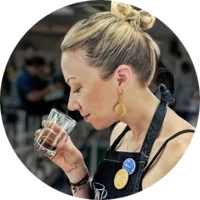
From our coffee sommelier
Maryna's weekly picks
“I taste thousands of coffees a year — I’ll only send you the few worth brewing.”
Something went wrong — please try again.
Free · Weekly · Unsubscribe anytime
Most home buying goes the opposite way. We pick by what the bag says. Bold. Smooth. World's best. Single-origin. Certified organic. And then we taste through that frame. The bag has already told us what to feel, and our brains generally cooperate. (This is also why people who claim a $20 bag and a $7 bag taste the same in a blind cupping sometimes turn out to be right. The marketing was doing all the work.)
A juror's framework is the reversal. Ignore what the bag is selling you, and look at the signals the bag can't fake. The roast date on a bag is a printed fact. You can't market a date into being something it isn't. Region specificity is either a fact or a vague gesture; you can tell which in two seconds. Process is named or it isn't. The bag either tells you who roasted this specific coffee for what reason, or it speaks in generic adjectives. Those signals are prior to the marketing, and they're what a juror's discipline tells you to look at.
The other thing disciplined cupping teaches you is that most coffees are pretty good at the specialty grade. Specialty starts at 80 or higher on the SCA's 100-point cupping scale, with no more than 5 defects per 350 grams. That floor already filters most of the world's coffee out. Within that floor, the question shifts from "is this coffee competent?" to "is this coffee interesting — is it sweet, balanced, clean, alive?" That's a different muscle. The framework below trains it.
How to use this: the five-point buyer framework
Five points, in this order. The order matters.
Point 1: Roast date. The single signal that overrides everything else. A specialty bag has a roast date printed somewhere, a real date, not a "best by" two years out. Two to six weeks past roast is the sweet spot. Espresso likes the later end of that range; filter is more sensitive to freshness within the window. Past six weeks, the coffee fades. Past three months, you're drinking the ghost of what it could've been. If a bag shows a "best by" date and no roast date, the roaster is treating the coffee like a shelf-stable commodity. Walk away. The freshness deep-dive goes further on why the window matters and how to make sure you're inside it.
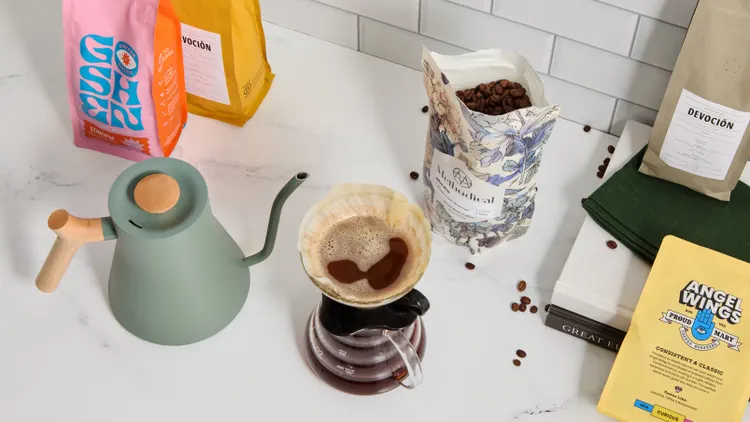
Point 2: Origin specificity. A specialty bag names a country and a region: Ethiopia Yirgacheffe, Colombia Huila, Honduras Marcala. Often it'll name a farm or cooperative. Vague labels ("South American Blend," "Premium Colombian") almost always cover vague coffee. Specificity is the roaster signaling: I know exactly what's in this bag, and you should too. The bag is telling on itself either way. The field-by-field label walkthrough is its own piece. If you want the clearest examples of what real origin specificity looks like, our single-origin coffees are where every label spells country, region, process, and notes.
Point 3: Process. Washed, natural, or honey. These are the three you'll see most. Washed coffees taste clean and origin-forward: Ethiopian florals, Kenyan brightness, Guatemalan chocolate. Naturals taste fruit-forward and sometimes fermented (strawberry, blueberry, the occasional boozy note). Honey lands in between: sweet and syrupy. Anaerobic and experimental processes get wilder: tropical, funky, sometimes polarizing. If a bag doesn't name the process, the roaster is either hiding a blend or hasn't bothered to tell you. Both are yellow flags.
Point 4: How the roaster talks about this coffee. This is the one most checklists miss, and it's the most diagnostic. Read the bag (or the product page) for what the roaster says about this specific coffee. Do they tell you why they roasted it the way they did? Do they name the producer? Do they describe the cup with sensory language (stone fruit, brown sugar, jasmine) or just adjectives like bold and smooth? A roaster who's actually cupped this with care will write about it specifically. Generic boilerplate is the tell. I look at hundreds of coffees a year from independent roasters across the US, and the gap between roasters who write about each coffee versus roasters who write the same paragraph about everything is enormous.
Point 5: The narrowing move. When the first four are equal, the fifth one breaks the tie. That's its own section below.
The narrowing move: when the first four are equal
When two bags pass all four checks (date, origin, process, roaster voice), the move I make is to read the tasting notes and ask which one I'm hungry for right now. Coffee is mood food. A clean Kenyan with blackcurrant and tomato leaf is a different morning than a syrupy Ethiopia natural with strawberry and chocolate. Pick the one your mouth is asking for.
The second narrowing move, if you're still stuck: pick the rarer or more unusual one. Specialty coffee gives you access to varietals like Geisha, Wush Wush, and Bourbon, and origins like Yemeni and Honduran Parainema, that you won't see anywhere else. Use a moment of indecision as an excuse for a small adventure.
This is a juror's habit too. At a cupping flight, when two coffees are scoring within a point of each other, what often breaks the tie at the table is which one I personally want to keep drinking. That counts. Our curator's-choice picks are the shortcut version. Coffees I've already narrowed down myself.
Start here
The framework is reusable. Carry it into any specialty bag you pick up, any roaster's website you browse. Same five questions, every time. That's the whole discipline.
I see this play out across dozens of independent roasters in our catalog every week. The roasters who answer all five points well are the ones I keep coming back to, and they're the ones I curate from most often. The framework is at the heart of how I curate for Bean Box now.
If you'd rather a curated path through coffees that already answer the five questions, our Coffee Plan exists for exactly that. I outsource my own framework to my fellow curators here at Bean Box. You get the curated bag instead of the homework.
Or, if you want to taste what the framework produces at the top end, our award-winning coffees are the bags that scored well in competitions like Cup of Excellence and Good Food Awards.
Trust the date, trust the specifics, then trust your tongue.
We want to help you make better coffee at home. Our recommendations are our own, and never sponsored. If you see something you love and buy it through our links, we may receive an affiliate commission (thanks for that!).
From our coffee sommelier
Maryna's weekly picks
“I taste thousands of coffees a year — I’ll only send you the few worth brewing.”
Something went wrong — please try again.
Free · Weekly · Unsubscribe anytime